
Natural Slate Roofing: History, Performance, and Cost
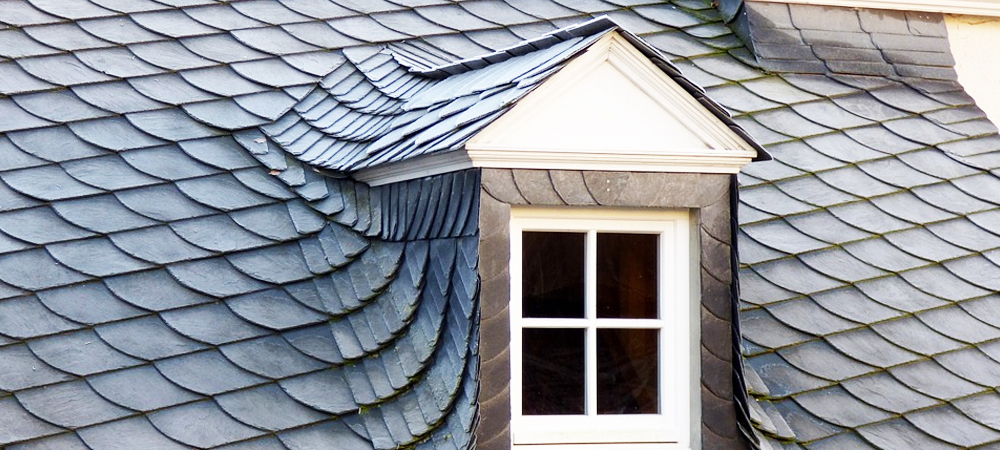
Natural roofing slate is a compact, fine-grained metamorphic rock. Its cleavage lets quarry workers split it into thin shingles without grinding or molding the stone. Roofers fasten each piece with nails or hooks and overlap the courses so water drains across the roof.
History of Slate Roofing
Roofing slate reached the American colonies by the seventeenth century. The National Park Service’s slate-roof preservation guide documents slate at Jamestown between 1625 and 1670, use in Boston by 1654, and the first commercial U.S. quarry in Pennsylvania in 1785. Production expanded after the Civil War as railroads connected quarries with growing cities.
Vermont remains a leading U.S. producer, but North American slate also comes from New York, Virginia, and Canada. Color, texture, strength, and weathering characteristics vary by quarry and bed.
How Long Does a Slate Roof Last?
Slate grade and installation determine service life. The National Park Service gives a range of 60 to 125 years or longer for many properly installed slate roofs. ASTM C406 classifies roofing slate as S1, S2, or S3 based on breaking load, water absorption, and weather resistance. The National Slate Association says S1 slate has an expected service life of more than 75 years, with some products lasting 100 to 175 years in service.
Those figures describe slate, not every component in the roof. Flashings, fasteners, underlayment, decking, and drainage details may need repair sooner. Quarry warranties also cover defined defects under stated conditions; they do not guarantee the service life of the complete roof.
Advantages of Natural Slate
- Long service life: High-quality slate can outlast many common roof coverings when a slate specialist installs and maintains it.
- Low water absorption: ASTM S1 slate permits no more than 0.25% absorption. That is low, but it is not zero.
- Fire performance: Slate itself is noncombustible. The fire rating still applies to the complete tested roof assembly, including the deck and underlayment.
- Natural variation: Quarries produce a range of colors, textures, thicknesses, and layouts without a printed surface pattern.
- Repairable courses: A slate roofer can replace individual broken pieces if compatible slate and sound surrounding materials remain available.
Tradeoffs and Structural Requirements
- Weight: The National Slate Association estimates about 935 pounds per roofing square for 1/4-inch slate and about 1,870 pounds per square for 1/2-inch slate at standard headlap. A roofing square covers 100 square feet.
- Structural review: Ask a qualified structural professional to evaluate framing and load paths before replacing a lighter roof with slate.
- Foot traffic: Slate can crack under a person’s weight. Use a contractor who knows how to access and stage work on slate roofs.
- Matching repairs: Natural color and texture vary by quarry and lot. A compatible replacement may not be an exact visual match.
- Specialized labor: Headlap, fastening, flashing, and metal compatibility affect the roof’s life. General roofing experience does not replace slate-specific training.
Hail and Fire Ratings
Do not apply one test result to every slate product. In National Slate Association testing, specified 3/8-inch S1 North American slate samples met FM 4473 Class 4 impact requirements, while specified 1/4-inch samples met Class 3. The test used ice balls of defined sizes and speeds at selected impact points.
A separate fire test used nominal 1/4-inch North American slate with a 3-inch headlap over No. 30 felt on a 1/2-inch plywood deck. That assembly achieved Class A. Before buying, confirm the test report or listing for the exact slate, deck, underlayment, slope, and installation method in the proposal.
Solar Reflectance and Energy Use
A slate roof does not produce one predictable energy-saving percentage. The U.S. Department of Energy says cool-roof savings depend on climate, roof reflectance and emittance, insulation, building use, and heating and cooling equipment. A reflective roof may reduce cooling demand in a hot climate but can reduce useful winter heat gain in a cold climate. Ask for tested values for the exact slate rather than relying on a material-wide claim.
Alternatives to Natural Slate
Fiber-cement, concrete, clay, and polymer-composite products can create a slate-like roof. Compare the exact products rather than relying on category averages. Check installed weight, impact and fire classifications, minimum slope, freeze-thaw testing, color warranty, repair availability, and the terms of the material warranty. Concrete and clay tile can also impose substantial dead loads, so neither should bypass structural review.
Slate Roof Cost
Published national estimates are only a starting point. A January 2026 planning guide from Fixr placed installed slate roofing around $9 to $30 per square foot, or $900 to $3,000 per roofing square. Local labor, slate type and thickness, roof pitch, access, tear-off, decking, flashing, structural work, and disposal can move a bid outside that range. Our roof replacement cost guide explains how to compare those line items across bids.
Ask each contractor to state the roof area, slate grade and source, thickness, headlap, fastener and flashing metals, underlayment, structural work, tear-off, disposal, labor, and warranty. Those details make competing bids easier to compare.